Ines Koch · 10 October 2026
Tracing the Evolution of Ranking Factors in Response to Platform Infrastructure Shifts
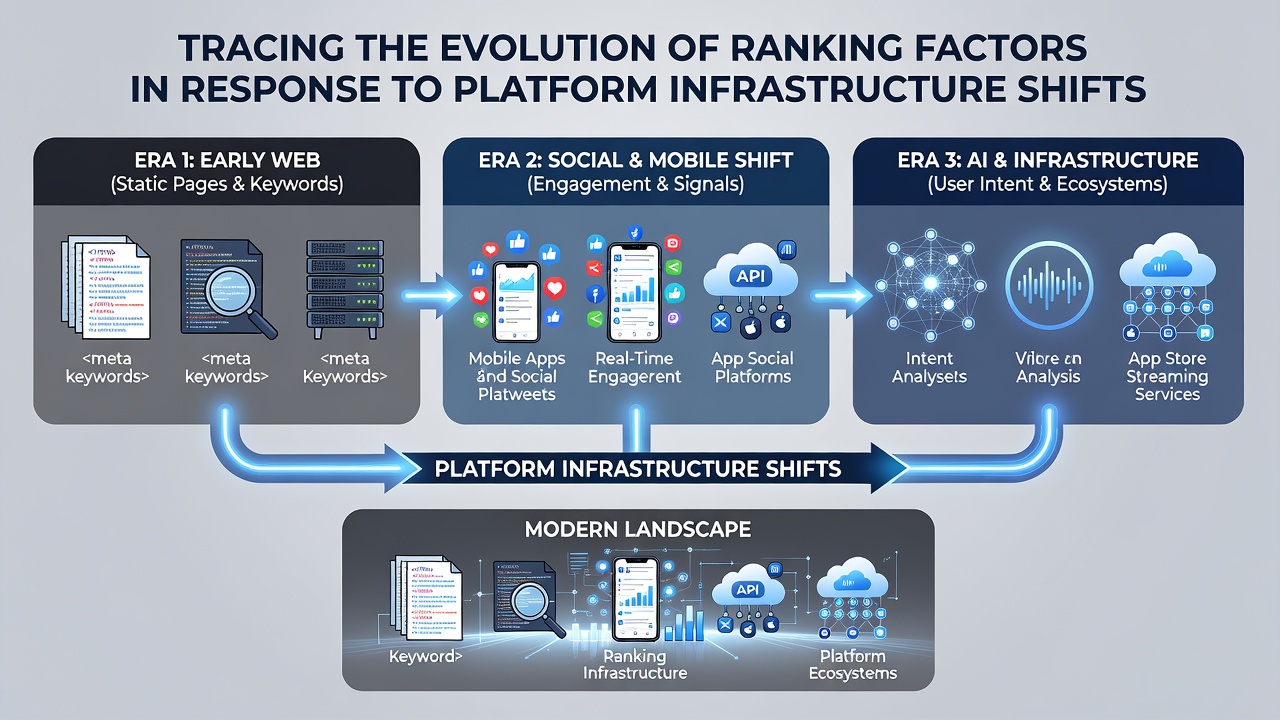
Search engines have adjusted their ranking factors repeatedly as underlying platform infrastructures expanded from basic server clusters to distributed global networks, and observers note that these adjustments often align with upgrades in data processing capabilities. Early systems relied heavily on keyword density and link counts because hardware constraints limited real-time analysis of complex signals, yet as cloud resources scaled up in the mid-2000s, engines began incorporating user engagement metrics derived from larger datasets.
Initial Infrastructure Constraints and Keyword-Centric Models
During the first decade of commercial search, limited storage and processing power forced algorithms to prioritize static page elements that could be evaluated quickly on single machines, and researchers documented how this led to heavy weighting of on-page text matches. Data centers operated in regional silos at that time, which restricted cross-referencing of user behavior across geographies and kept ranking formulas relatively simple. As fiber optic networks and early virtualization tools emerged, platforms gained the ability to index larger portions of the web without proportional increases in latency, prompting gradual inclusion of freshness signals tied to update frequency.
Cloud Expansion and the Rise of Technical Performance Metrics
Platform providers migrated workloads to elastic cloud environments around 2010, which enabled continuous crawling at higher volumes adn introduced ranking factors based on site speed and server response times. Studies from academic institutions showed that pages hosted on faster infrastructure received preferential treatment once engines could measure load times accurately across multiple locations. Mobile network improvements further influenced this phase, as carriers upgraded 3G and 4G coverage, allowing algorithms to factor in mobile-friendliness scores derived from real-device testing rather than simulated environments.
AI Integration Following Data Center Modernization
By the late 2010s many search platforms had consolidated operations into hyperscale facilities equipped with specialized tensor processors, and this hardware shift supported machine learning models that evaluated hundreds of signals simultaneously. Evidence from industry reports indicates that quality assessments moved beyond basic link graphs to include semantic understanding of content, while infrastructure changes also facilitated deeper analysis of dwell time and bounce patterns collected at scale. One notable development occurred when distributed storage systems reduced the cost of retaining user interaction logs, allowing models to refine rankings based on aggregated behavioral data without exceeding computational budgets.
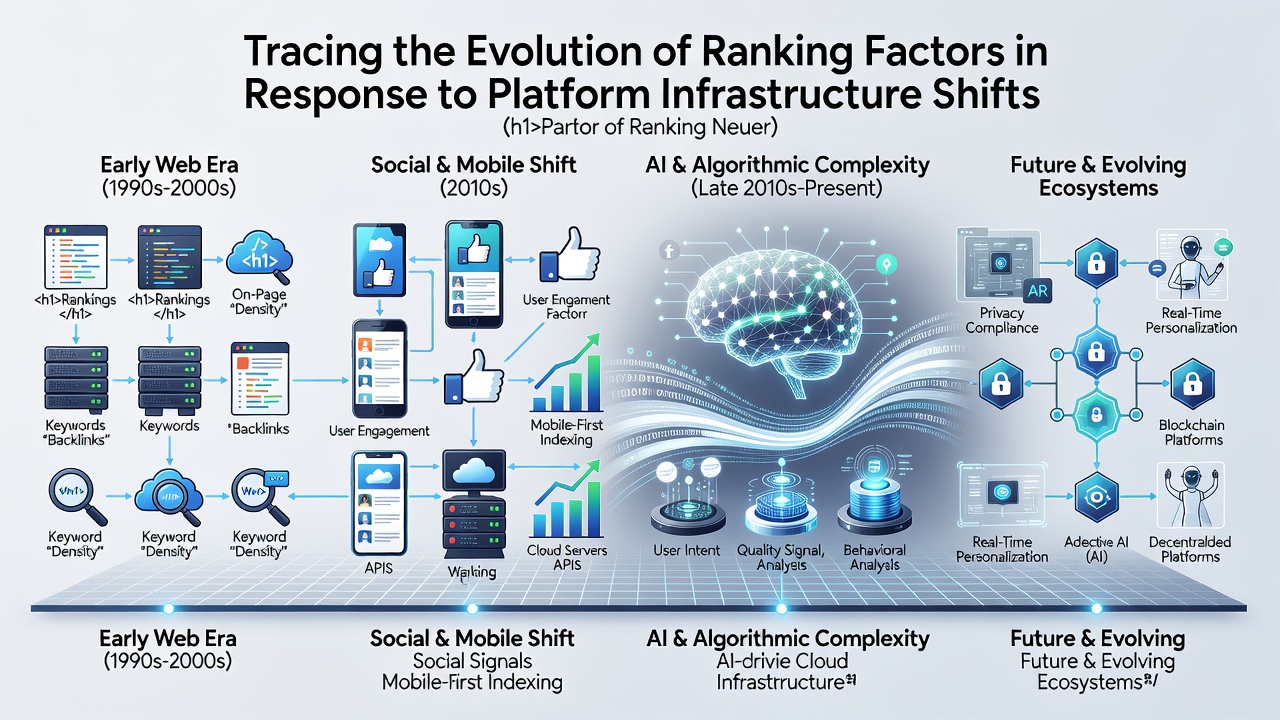
October 2026 marked another infrastructure milestone when several major engines completed migrations to edge-computing nodes positioned closer to end users, and analysts recorded corresponding updates that elevated core web vitals variants focused on interaction latency measured at the device level. Government data from the Australian Competition and Consumer Commission highlighted how these network changes affected smaller regional sites differently than large content networks with dedicated caching agreements. Australian Competition and Consumer Commission reports on digital infrastructure documented measurable differences in crawl frequency tied to proximity of edge nodes.
Security and Privacy Infrastructure Driving New Signals
Encryption mandates and privacy regulations required platforms to redesign data pipelines, which in turn affected how engines handled referral data and user location signals. Research from the European Commission's digital infrastructure programs shows that sites adopting privacy-preserving analytics frameworks maintained visibility when engines began down-weighting pages that transmitted unencrypted user data through outdated server configurations. Those shifts coincided with broader adoption of zero-trust architectures inside data centers, enabling more granular tracking of content authenticity without compromising compliance requirements.
Current Landscape After Recent Upgrades
Following the 2026 edge-network deployments, ranking systems now incorporate real-time metrics gathered from content delivery points distributed across continents, and figures from multiple regulatory bodies reveal that entities with robust local infrastructure partnerships achieve faster indexation cycles. Observers have tracked how changes in power-efficient chipsets within these facilities allowed engines to process multimodal content signals, such as video frame analysis, at lower operational costs than previously possible. Take one research team that examined server log patterns after the upgrades and found that pages optimized for both speed and regional availability climbed in results more consistently than those relying solely on traditional optimization techniques.
Conclusion
Platform infrastructure shifts continue to reshape the weighting of ranking factors as processing power, network topology, and storage architectures evolve, and historical patterns demonstrate that engines adapt their evaluation methods once new capabilities become cost-effective at scale. Entities monitoring these changes often align technical improvements with documented infrastructure milestones to sustain visibility across evolving search landscapes.