Ines Koch · 24 October 2026
Navigating Content Reorganization Tactics in Response to Hosting Environment Transitions
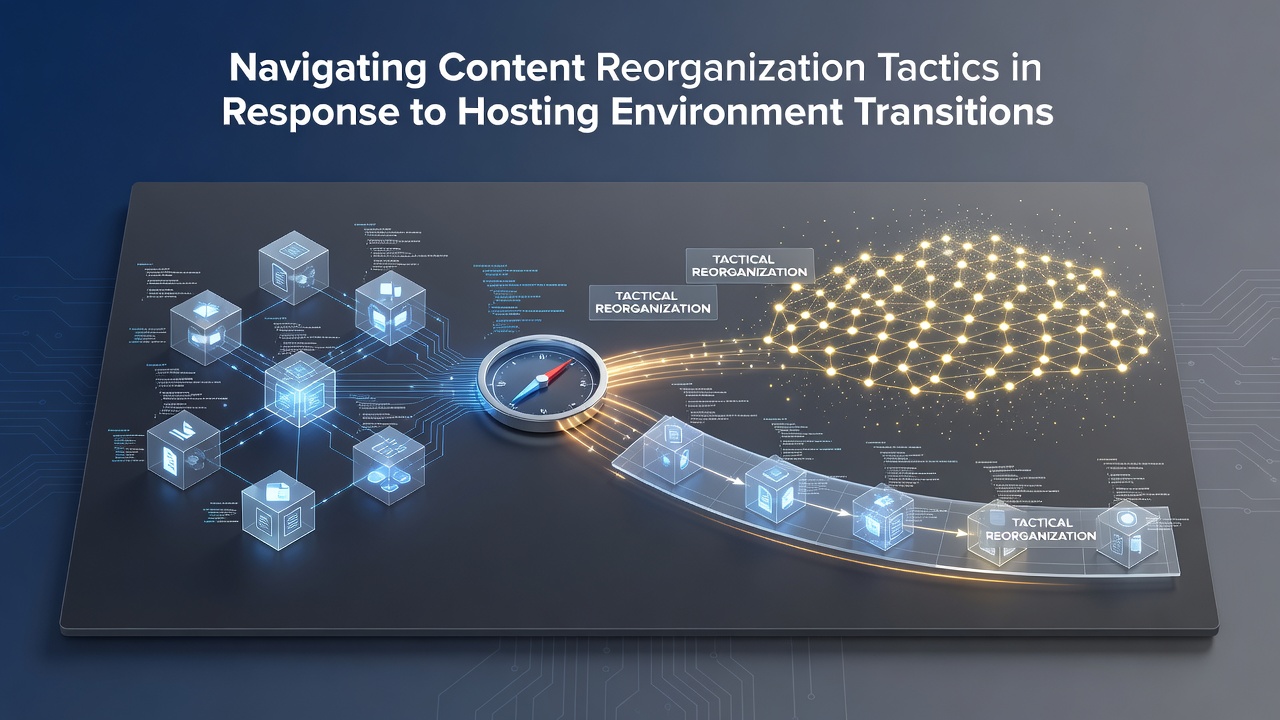
Hosting environment transitions force organizations to rethink content structures because new servers often introduce different performance baselines, caching rules, and URL handling protocols. Research indicates that companies moving from traditional shared hosting to cloud-based infrastructures frequently encounter indexing fluctuations unless they reorganize navigation hierarchies and internal linking patterns ahead of the switch. Data from infrastructure monitoring tools shows that page load variances can exceed 40 percent during the first weeks after migration when content remains unoptimized for the target platform.
Assessing the Scope of Required Reorganization
Teams begin by mapping every asset against the capabilities of the incoming environment, since cloud providers may enforce stricter content delivery network rules or alter how static files resolve. Observers note that thorough inventories conducted before October 2026 revealed many sites still carried legacy folder structures incompatible with containerized deployments. Those assessments typically include file size audits, duplicate content scans, and dependency checks on scripts that reference absolute paths tied to the old host.
Experts have observed that failing to adjust image compression settings or JavaScript bundling strategies often leads to crawl budget waste once the new hosting environment activates its own optimization layers. Studies found that sites which consolidated media libraries and removed orphaned assets before migration maintained steadier organic traffic curves compared with those that deferred reorganization.
Developing URL and Navigation Frameworks
Content reorganization centers on creating logical URL patterns that align with the new server architecture while preserving equity from established backlinks. Professionals frequently employ automated redirect mapping tools to generate 301 rules for every changed path, and they test those rules in staging environments that mirror the production hosting setup. The process grows more complex when the transition involves moving from region-specific data centers to globally distributed nodes, because geo-targeted content may need new folder hierarchies to match latency expectations.
Performance-Driven Content Adjustments
Once the hosting change occurs, teams monitor server response headers and adjust content delivery accordingly. For instance, sites adopting edge computing hosts often split long-form articles into modular components that load asynchronously, reducing time-to-first-byte metrics reported by monitoring platforms. Figures reveal that such modular approaches became more common as organizations scaled operations throughout 2026.

Testing and Validation Protocols
Validation cycles incorporate both automated crawlers and manual review sessions that verify internal links resolve correctly under the new hosting configuration. According to guidance from the National Institute of Standards and Technology, systematic logging of redirect chains helps identify loops that could otherwise degrade search engine crawling efficiency. Teams also compare pre-migration and post-migration crawl reports to quantify any shifts in indexed page counts or duplicate content flags.
European research institutions have documented cases where organizations that integrated schema markup updates during reorganization saw faster recovery in rich result eligibility after hosting transitions. Those projects typically involved rewriting structured data references to reflect new canonical URLs and updating sitemap references to point at the revised content architecture.
Coordination Across Teams
Successful reorganizations require close alignment between development, SEO, and content teams because hosting changes can affect everything from database queries to metadata rendering. Project timelines often allocate separate phases for content freezing, migration execution, and post-launch monitoring so that unexpected indexing delays receive prompt attention. Industry reports compiled by research groups in Australia highlight that cross-functional checkpoints conducted at 48-hour intervals after go-live helped surface issues such as misconfigured cache headers before they compounded.
Yet organizations continue to refine these sequences as hosting providers release new features that influence how content should be structured for optimal delivery.
Conclusion
Content reorganization during hosting environment transitions follows a repeatable sequence of inventory, mapping, adjustment, and validation steps that protect search visibility and user experience. Organizations that execute these steps methodically demonstrate more stable performance indicators once the new infrastructure stabilizes. Continued monitoring remains essential because hosting platforms evolve their optimization features regularly, requiring ongoing content refinements to match updated delivery parameters.